This concept project is a scenario-based e-learning experience designed to help new managers boost team morale and increase sales by effectively applying the appropriate leadership style.
The Problem
Creative Technologies, Inc. (CTI) is a conceptual company that has been in business for one year. However, it is facing a real-world problem: team morale is low, and sales are steadily declining. To better understand this two-pronged issue, I conducted a needs analysis. The findings revealed that none of the managers had received leadership training. They were also unaware of the various leadership approaches that could better support their teams and departments. The problem was both knowledge and skills based.
The Solution
After identifying the problem, I considered a variety of solutions and ultimately proposed a scenario-based e-learning experience. One of the key benefits is that managers can practice applying various leadership styles in a risk-free environment, using realistic scenarios tailored to the needs of both teams and the business. This approach is also grounded in research. Effective leaders are “skilled at several [leadership] styles and have the flexibility to switch between styles as the circumstances dictate” (Goleman, 2000).
My Process
After considering ADDIE (linear), SAM (agile), or a hybrid approach, I focused mainly on the ADDIE model.
Action Map
I implemented an eclectic strategy alongside the ADDIE model, integrating Adult Learning Theory and some of Merrill’s Instructional Design Principles, both of which emphasize problem based and active learning. Additionally, the ABCD Model was used to focus on clear learning outcomes that emphasize specific actions learners must perform. ABCD stands for Audience, Behavior, Condition, and Degree.
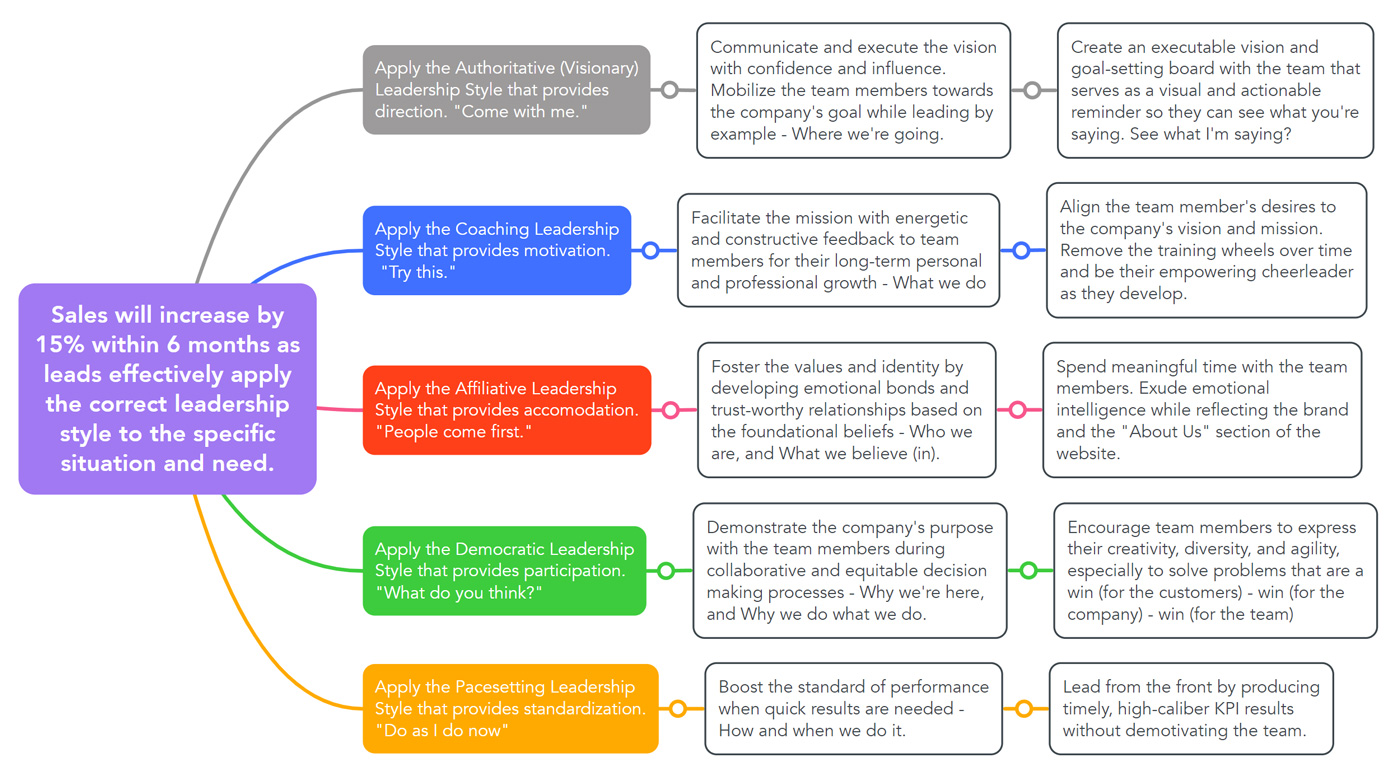
This integrated approach was guided by the action mapping process. A measurable performance goal was proposed and is stated on the left side of the action map below. The focus was on high priority actions that focused mostly on behavior change. Verbiage from Bloom’s (Digital) Taxonomy was used when possible.
I acted as the subject matter expert (SME) and that came naturally with my leadership experience as a small business owner, previous construction project manager, and previous leadership course director.
Text-based Storyboard
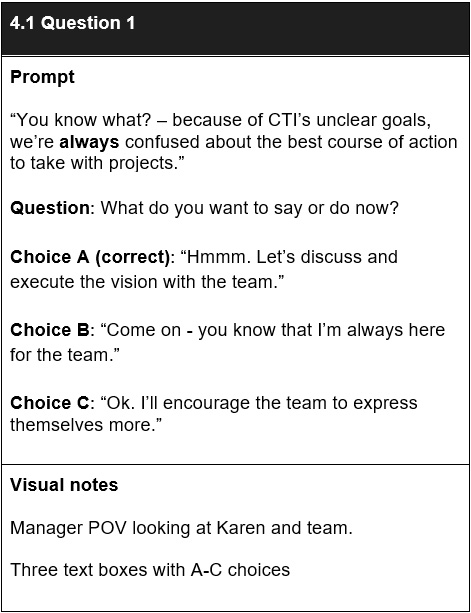
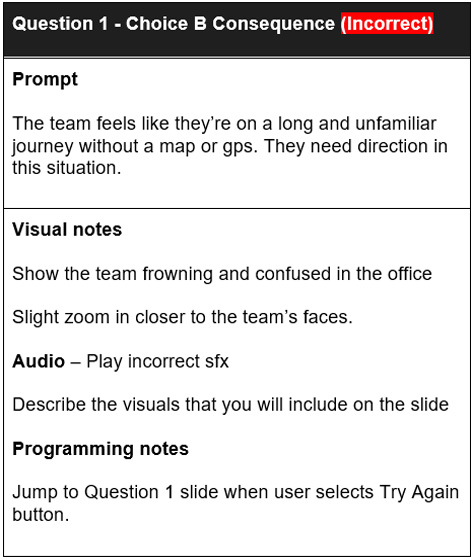
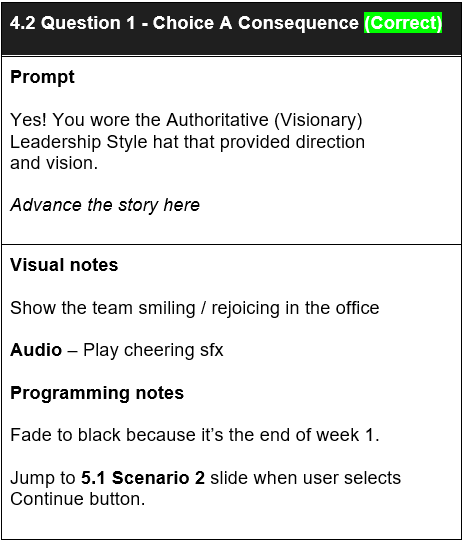
Some proprietary details are excluded from these examples. After identifying key actions, I highlighted observable tasks and behaviors in a storyboard with meaningful choices and consequences.
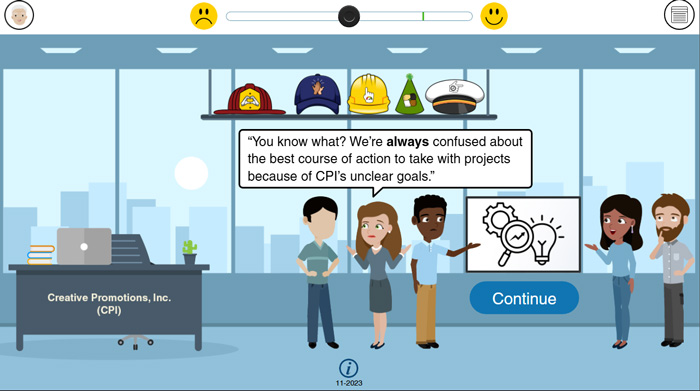
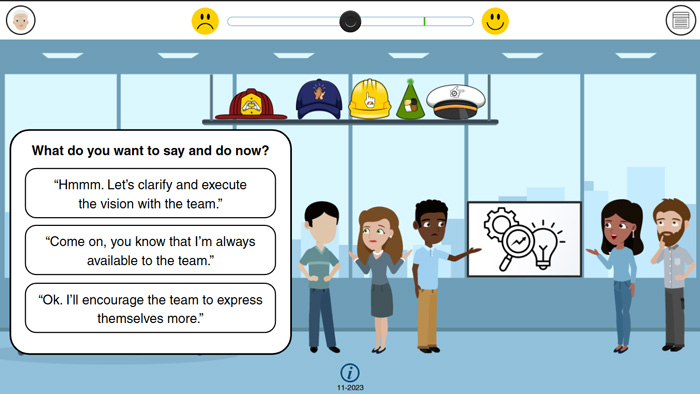
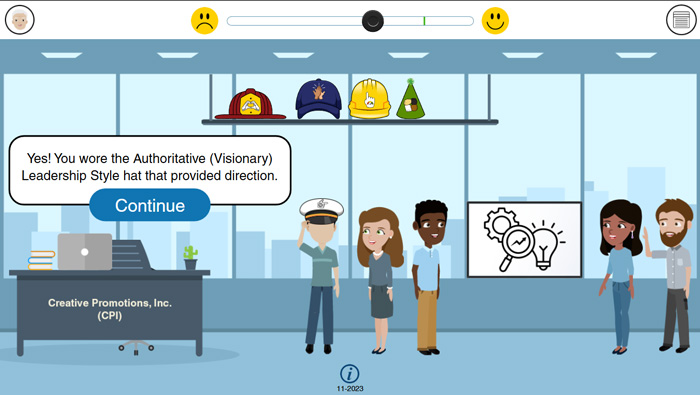
Participants practice leadership agility by choosing from one correct and two incorrect options in each scenario. Five different hats represent leadership styles, but their meanings are not revealed. A correct choice places the matching hat on the participant’s head with a team cheer — inspiring the title Leadership Stylin’ and Profilin’.
Incorrect choices produce a sound effect, an explanation, and a “Try Again” option. A mentor character, Mikado, and a job aid offer guidance as needed throughout the experience. Immersion is enhanced through sound effects and responsive team facial expressions. Below are the edited storyboard screenshots.
Visual Mockups
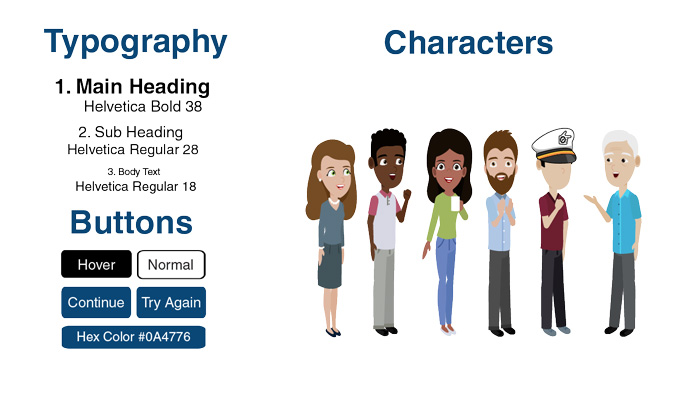
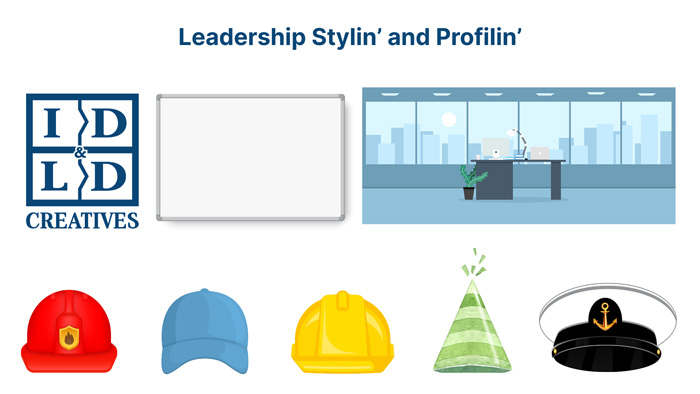
The visual design and mockups were based on the storyboard. I created a mood board for inspiration and a style guide for consistency. Using my company’s logo, I selected complementary brand colors and typography. The colors and Helvetica font were selected to meet accessibility standards.
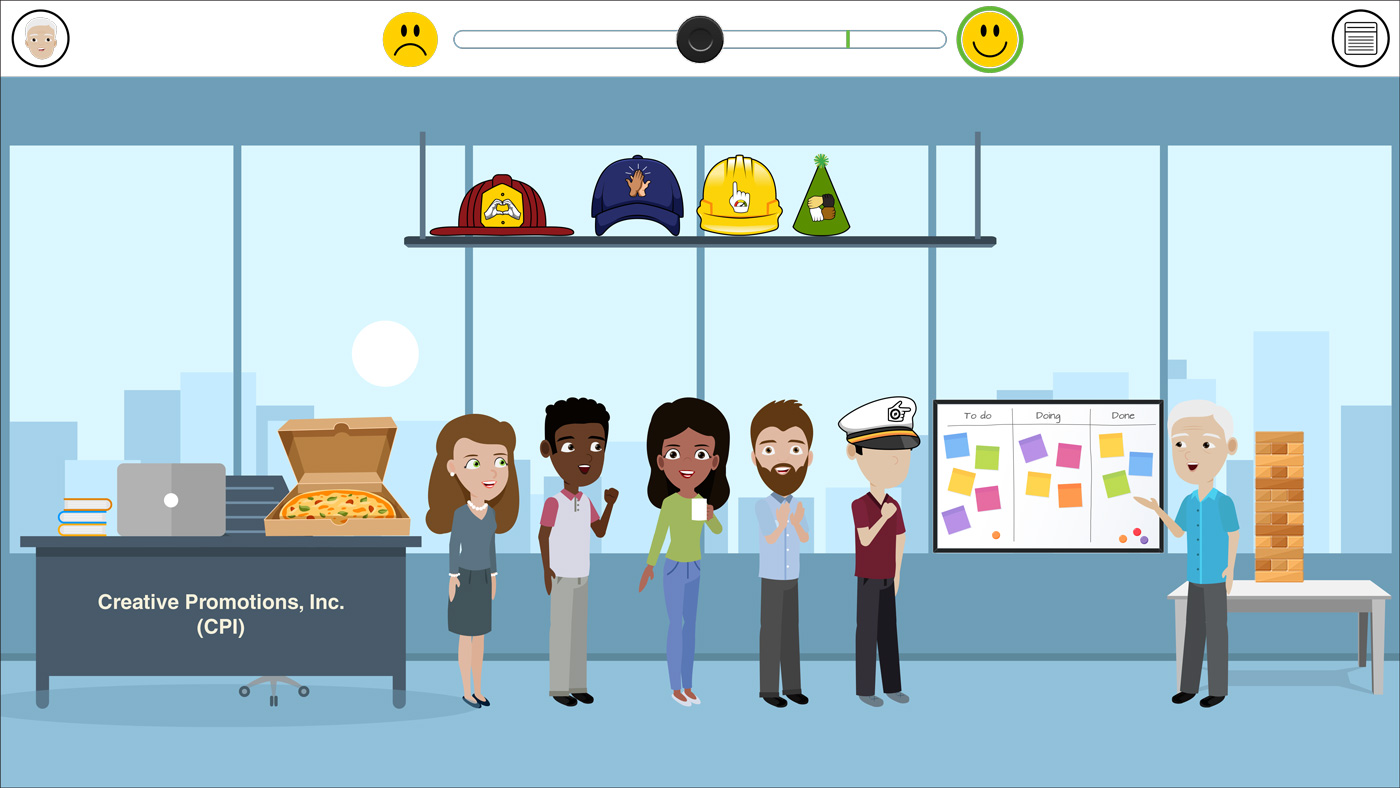
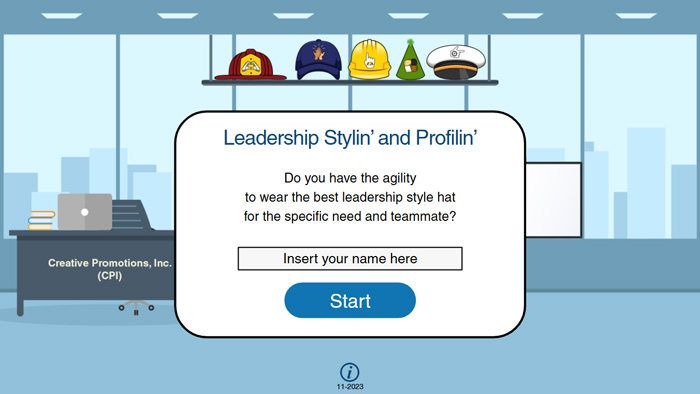
I reviewed many images and selected a spacious office scene, rearranged furniture, and cleared the desk to fit up to six characters. The whiteboard displayed a different image in each scenario. Each hat had its own color, purpose, and meaning.
Finding a diverse character set from one source was challenging. Each scenario required different poses and facial expressions. I eventually selected five representative team members and one experienced mentor. The manager character is faceless to allow users to see themselves in the role. Clothing and colors changed with each scenario.
Full Development
I proceeded to full development with Articulate Storyline after testing and receiving multiple rounds of feedback on my interactive prototype. My experience as a digital and university project manager was especially valuable during development. I focus on delivering a quality product within scope, schedule, and budget.
Results
Real Testimonials
“It’s very well done, engaging, and beautiful.” Sydney M. (Instructional Designer)
“Lester! I loved it!!! I do have some feedback, but I LOVE the vision and direction.” – Lori G.
“Lester, this is amazing! I like the scenarios and the application. You’ve truly got a vision here.” – Marlaina C.
Lessons Learned
I was reminded of the importance of testing early and often. I think I did well in gathering and implementing feedback. Next time, I’ll aim to balance following the plan with pivoting when necessary.
The eLearning experience can be exported in multiple formats, including versions compatible with an LMS. This allows data to be collected via SCORM or xAPI. The Kirkpatrick Model can then be used to evaluate the effectiveness of the training.